
The copper telephone network that has carried Isle of Man phone calls and broadband for decades is being switched off. Manx Telecom has committed to completing the switch-off no later than 2029, as services move to the island's fibre network, and the Communications and Utilities Regulatory Authority (CURA) is overseeing the transition zone by zone. For most homes it means a new router and a short appointment. For businesses it can mean much more: phone systems, alarm lines, lift phones, card terminals and broadband all need checking before the date arrives.
This guide explains how the switch-off works, what typically depends on copper in an Isle of Man business, and the steps to take now so the move happens on your timetable rather than your provider's.
What is changing, and when
CURA's switch-off plan divides the island into seven zones. Each zone moves off copper in phases. Phase 1 covers premises that are straightforward to transfer and within easy reach of fibre; premises that need extra help, extra works or specialist equipment are dealt with in later phases. According to CURA, around 26,200 copper lines were still in use across the island in November 2025, so there is a lot still to move.
The Phase 1 start dates published by CURA are:
- Zones 1 and 2: March 2025
- Zone 3: May 2025
- Zone 4: July 2025
- Zone 5: October 2025
- Zone 6: January 2026
- Zone 7: 2027, with letters to follow once details are confirmed
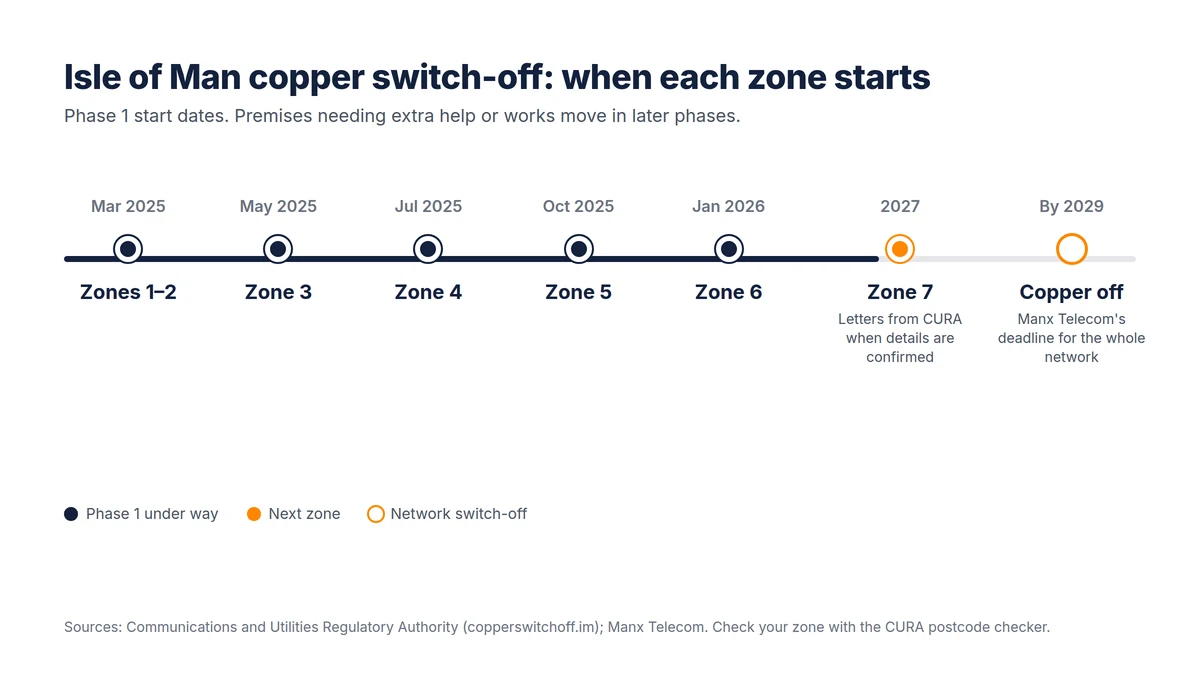
CURA's website has a map and postcode checker showing which zone each address is in. If your business has more than one site, check each one: a shop in Ramsey and an office in Douglas may well be in different zones, with different dates.
How the transition works for your premises
CURA sets out a five-step process:
- A letter from the Authority tells you your zone is being transferred.
- Your service provider contacts you to understand your needs and whether you qualify for a temporary exclusion.
- You take time to decide which new service suits you.
- You agree a plan within about 12 months of your provider first contacting you, and your service is transferred.
- Network support is withdrawn after 12 months unless you have a temporary exclusion. If a copper service develops a fault after that point, your provider will not be able to fix it.
That last step is the one businesses should take most seriously. A copper line will not simply stop on a set day, but once support is withdrawn a single fault could leave you without phones or an alarm connection, with no quick repair.
Temporary exclusions
CURA recognises that not everyone can move straight away. Temporary exclusions cover situations such as specialist devices, panic buttons, security alarms and lift lines that work over the current service; premises that need extra works before fibre can be connected; the need for permission from a landlord or local authority; and, explicitly, the need to make sure a business's requirements are met. If an exclusion applies, CURA says your current service will continue until an appropriate solution is in place. The responsibility is on you to tell your provider about these needs.
What in your business still depends on copper
The obvious items are phone lines and copper-based broadband. The less obvious ones are devices that quietly use a phone line to send alerts or take payments. Typical examples in island businesses include:
- Phone lines and older phone systems, including any on-site PBX connected to analogue or ISDN lines;
- broadband delivered over copper, rather than full fibre to the premises;
- intruder and fire alarms that dial out to a monitoring centre;
- lift emergency phones and door entry systems;
- card payment terminals that still use a phone line;
- franking machines, fax machines and remote monitoring of plant, heating or CCTV;
- care and telecare equipment, for example in care homes or sheltered housing.
Manx Telecom has set up a Future Ready Team to handle copper-dependent services such as lift emergency lines, personal alarms, security systems and payment terminals, and asks customers to register them through its copper-dependent services web form. It says alternative solutions are in development, so a full system replacement may not always be necessary. Registering early gives you, and the people who maintain your alarms and lifts, time to agree what happens.
Talk to the companies that maintain this equipment too. Alarm, lift and payment providers will know whether their devices can move to an IP or mobile connection, and how long that takes.
Phones: moving from a copper line to VoIP
Traditional landlines are being replaced by digital voice services, known as VoIP, which run over a fibre broadband connection. CURA's phone guidance lists what a fibre-based VoIP service needs:
- a connection to the fibre network;
- a compatible router;
- access to the internet (though not necessarily a separate broadband package if you only want calls);
- a subscription to a VoIP service;
- a digitally enabled handset.
CURA notes that moving a service to fibre may involve a one-off connection fee, and that if extra installation work is needed before fibre can be connected, it is worth getting two or three quotes.
A single line or a business phone system?
If you have one or two lines and simple needs, moving those lines to your provider's fibre voice service may be all that is required. If several people take calls, transfer them, use hunt groups or work from home in Onchan, Peel or Port Erin as well as the office, the switch-off is a good moment to look at a hosted phone system instead. With a cloud phone system the switchboard runs in a data centre, and desk phones, softphone apps and mobiles all connect over the internet. Our guide to cloud phone systems vs a traditional PBX compares the two, and Hypercloud Voice is Omega IT's cloud phone system.
If your business has 01624 numbers that customers know, ask before you change anything how they will be kept. Moving to your current provider's fibre voice service transfers your existing service; moving to a different provider or a hosted system means arranging for the numbers to be moved first. Do not cancel old lines until the numbers are working on the new service.
Plan for power cuts
A copper phone line took its power from the exchange, so a corded phone usually kept working during a power cut. Fibre does not. Manx Telecom's fibre service description states that fibre services are not independently powered from the exchange and will not provide emergency telephone access during a power cut affecting the equipment at your premises, and it advises battery backup if you need fixed-line access without mobile calling. For a business that means:
- a UPS (battery backup) for the fibre terminal, router and network switch that carry your calls;
- call diversion to mobiles if the office goes offline, which hosted phone systems can do automatically;
- a decision about anything safety-related, such as lift phones and alarms, that must keep working during an outage.
Broadband: choosing the right fibre service
For many businesses the switch-off is also a broadband upgrade. Manx Telecom says that more than 90% of homes and businesses could already access fibre when it announced the 2029 deadline. When choosing a business fibre service, look beyond the headline speed:
- Upload speed and consistency matter for cloud services, video calls and VoIP. Test your current connection with our speed test at busy times of day.
- Fixed IP addresses are needed for some remote-access, CCTV and firewall setups. Manx Telecom's business fibre plans include one fixed IP as standard.
- Contract terms. Business fibre plans are typically taken on a minimum term, and changes can restart it, so check before you sign.
- Installation requirements. Manx Telecom installs the fibre socket close to where the cable enters the building and needs a power socket nearby. Agree the location with whoever looks after your comms cabinet.
- A second connection from a different provider protects against a single fault taking the business offline. Businesses with several sites can combine connections using SD-WAN.
Landlords, shared buildings and multiple sites
Many island businesses rent space in shared buildings in Douglas or on business parks in Braddan. Before fibre can be installed you may need the landlord's permission, and both CURA and Manx Telecom say permission from the property owner may be required. Shared services also need an owner: in a multi-tenant building, the lift line, fire alarm and door entry system usually belong to the landlord or managing agent rather than to any tenant. Ask them what their plan is, because your staff and visitors rely on those systems too.
If you operate from several premises, treat each one as its own project. They may be in different zones, have different equipment on copper and need different solutions. An up-to-date list of every line, number and device per site is the single most useful thing you can produce. Our guide to IT infrastructure management explains how to keep that kind of record current.
Copper switch-off checklist for Isle of Man businesses
- Check the zone for every site using CURA's postcode checker.
- Find out whether CURA or your provider has already written to you, and when you were first contacted.
- List every line and number from your phone and broadband bills, and what each one is for.
- Walk the building and record every device that might use a line: alarms, lift, door entry, card terminals, franking, fax and remote monitoring.
- Register copper-dependent services with Manx Telecom's Future Ready Team, and contact the companies that maintain each device.
- Decide between fibre voice lines and a hosted phone system, based on how your team takes calls.
- Confirm how your existing numbers will be kept before anything is cancelled.
- Choose a business fibre service, and check upload speed, fixed IP needs and contract terms.
- Plan for power cuts: battery backup for network equipment and call diversion to mobiles.
- Get landlord permission for installation, and ask how shared building systems will be handled.
- Book the transfer for a quiet period, and test calls, alarms and payments afterwards.
- Tell your provider straight away if you need a temporary exclusion.
Common questions
Will my business be cut off without warning?
No. CURA writes to affected premises, your provider then contacts you, and you have about 12 months to agree a transfer. If a temporary exclusion applies, CURA says your service continues until a suitable solution is in place. The risk is waiting too long: once network support is withdrawn, faults on copper services may not be repaired.
Do I need broadband to keep a phone line?
Not necessarily. CURA says that if you only want to make calls, you do not need to pay for a broadband service, although the VoIP service still runs over a fibre connection and a compatible router.
Will our alarm keep working after the switch?
Not always without changes. Some alarms and care devices do not work over some alternative services. Speak to your alarm company and register the line with Manx Telecom's Future Ready Team before your transfer date.
Can we keep our 01624 numbers?
Ask your provider before you agree a plan. Moving to the same provider's fibre voice service transfers your existing service. If you are moving to a different provider or a hosted phone system, arrange for the numbers to move first and only cancel the old lines once they are working.
Will our phones work in a power cut?
Not unless you plan for it. Fibre services are not powered from the exchange, so you need battery backup for your network equipment, or a fallback such as mobiles.
How Omega IT can help
Omega IT is based in Douglas and supports businesses across the Isle of Man. We can help you audit what still runs over copper at each site, plan the move for phones and broadband, build in resilience for power cuts and line faults, and, where it fits, move your team to Hypercloud Voice. Read about our managed IT support, book a free IT Discovery Session or contact us.
Sources
- Communications and Utilities Regulatory Authority: The Plan, The Transition Process and Phone, copperswitchoff.im
- Manx Telecom: 2029 deadline for copper network switch-off (10 December 2024)
- Manx Telecom: Pre-emptive support initiative for lift lines and personal alarms
- Manx Telecom: Fibre to the Premises services description and business fibre broadband
- Sure Isle of Man: Copper switch-off information
Related reading
- Cloud phone systems vs PBX: a guide for Manx businesses
- SD-WAN for Isle of Man businesses with multiple sites
- Isle of Man cyber threats 2026: lessons for firms
Image credits: featured image of Peel by Oliver King on Unsplash; telephone pole by Sunrise King and router by Compare Fibre, both on Unsplash, used under the Unsplash License. Timeline diagram by Omega IT.